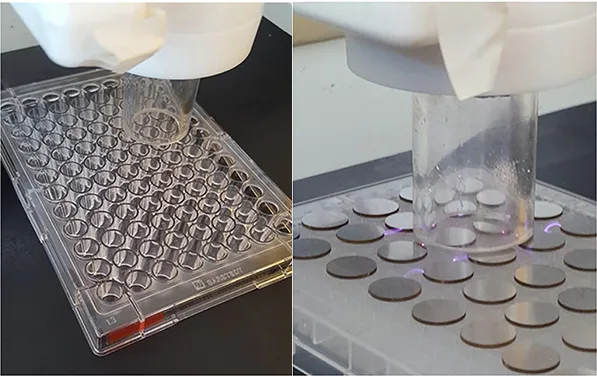
Antimicrobial coatings have emerged as an effective tool for preventing or ameliorating medical device-related infections. This study investigated a plasma deposition process designed to apply pharmaceutical drugs directly onto various surfaces while maintaining their structural integrity and antimicrobial efficacy against mono-species biofilms. Two antibiotics, ampicillin and gentamicin, were deposited onto polystyrene microtiter plates and stainless steel coupons. The efficacy of these coated surfaces was tested against both planktonic and sessile populations of Escherichia coli and Pseudomonas aeruginosa over a 14-day monitoring period. The plasma process successfully bonded the antibiotics to the surfaces while ensuring localized retention of activity. These coatings effectively neutralized planktonic cells and prevented biofilm formation for up to 96 hours. Furthermore, the antibiotics eluted into the surrounding medium and remained effective for up to two weeks. Control experiments confirmed that the helium plasma process itself had no independent antimicrobial or growth-promoting effects. Because this method requires no linkers or modified polymers, it minimizes biocompatibility issues and offers a promising solution for controlling infections at surgical or implant sites.